
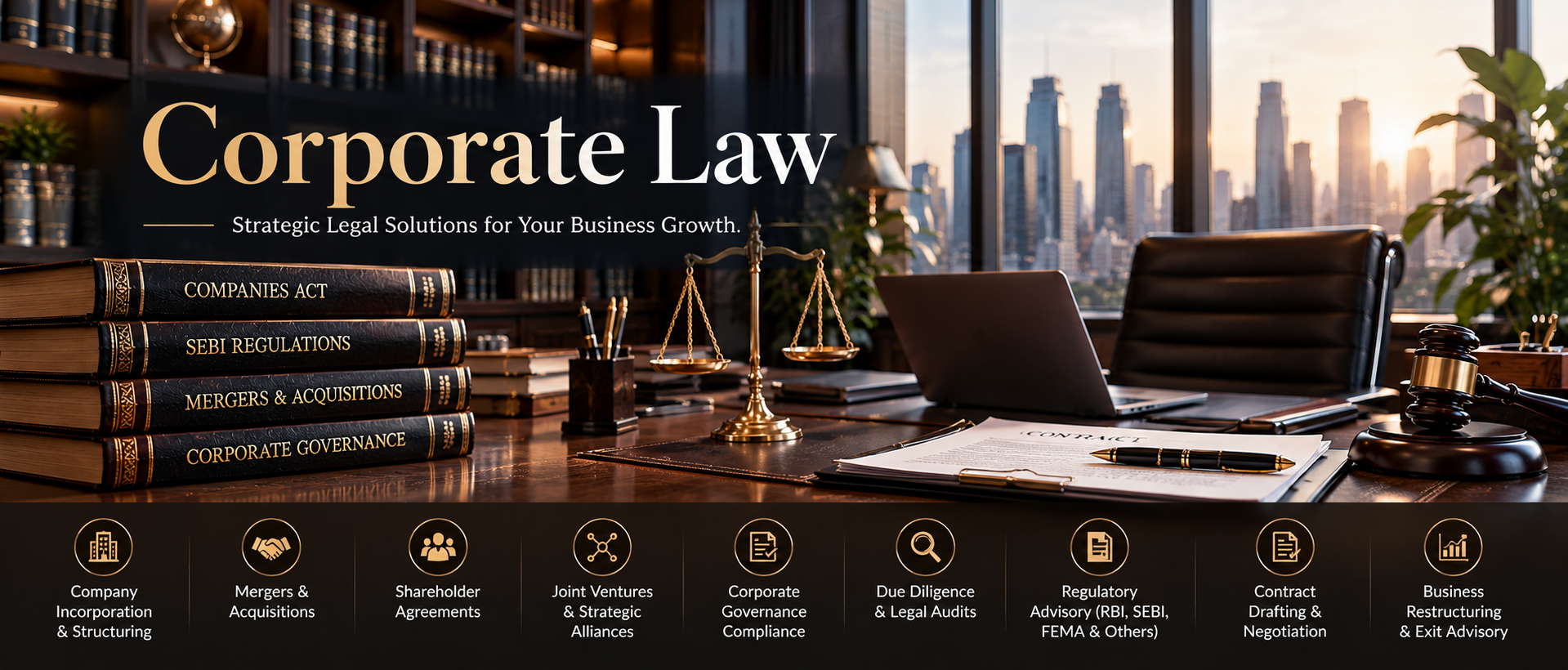
Corporate law plays an important role in the way businesses are established, managed, regulated, and expanded. From setting up a company and preparing commercial agreements to handling regulatory requirements, shareholder matters, mergers, acquisitions, and corporate disputes, businesses regularly require legal guidance at different stages of their journey.
A strong corporate legal framework helps businesses make decisions with greater clarity while reducing avoidable legal and commercial risks. Whether it is a growing startup, an established company, or a large corporate group, having appropriate legal support can help ensure that important business decisions remain aligned with applicable laws and contractual obligations.
Understanding Corporate Law
Corporate law covers the legal structure and functioning of companies and other business entities. It deals with the rights and responsibilities of companies, directors, shareholders, promoters, investors, and other stakeholders.
Corporate legal matters can arise at almost every stage of a business. Incorporation, investment, contracts, corporate governance, restructuring, compliance, employment arrangements, intellectual property, financing, and dispute resolution may all require legal consideration.
The right legal approach depends on the nature, size, industry, and objectives of the business. A growing company may require assistance with investment and shareholder arrangements, while an established organisation may need support for restructuring, acquisitions, regulatory compliance, or complex commercial transactions.
Company Formation and Structuring
Choosing the right legal structure is one of the first important decisions for a business. The structure can influence ownership, management, taxation, liability, investment opportunities, and future expansion.
Legal assistance during incorporation can help promoters understand their rights and obligations and establish appropriate documentation between stakeholders. Shareholding arrangements, management responsibilities, decision-making mechanisms, and exit provisions can be addressed at an early stage to reduce the possibility of future disagreements.
A properly structured business provides a stronger foundation for future growth and investment.
Corporate Governance
Good corporate governance is essential for maintaining transparency, accountability, and responsible decision-making within an organisation. Directors and management are expected to perform their roles in accordance with applicable legal and regulatory requirements.
Corporate governance may involve board procedures, shareholder meetings, resolutions, disclosures, related-party transactions, internal policies, and other compliance requirements.
Legal advice can help businesses understand their responsibilities and develop processes that support informed and compliant decision-making. Strong governance practices can also improve confidence among investors, business partners, employees, and other stakeholders.
Shareholder and Investor Matters
Relationships between shareholders can become complicated as a company grows. Differences may arise regarding ownership percentages, management decisions, investment rights, voting powers, dividend arrangements, or the future direction of the business.
Shareholder agreements can provide a framework for managing these issues. Such agreements may address matters including transfer of shares, rights of existing shareholders, decision-making, funding obligations, exit mechanisms, and dispute resolution.
For businesses raising external investment, legal review of investment documents is particularly important. The terms of an investment can have long-term implications for control, ownership, management, and future fundraising.
Commercial Agreements and Contracts
Contracts form the foundation of most commercial relationships. Businesses enter into agreements with customers, suppliers, service providers, distributors, consultants, technology partners, investors, and other parties.
A well-drafted contract should clearly define the rights and obligations of each party. Payment terms, deliverables, timelines, confidentiality, intellectual property ownership, liability, termination, dispute resolution, and other important provisions should be considered carefully.
Legal review before signing an agreement can help identify unclear provisions, excessive obligations, potential liabilities, and terms that may create difficulties later.
Mergers, Acquisitions and Corporate Restructuring
Businesses may restructure their operations for a variety of reasons, including expansion, investment, consolidation, succession planning, or entering new markets. Mergers and acquisitions can involve significant legal and commercial considerations.
Due diligence is an important part of such transactions. It may involve reviewing corporate records, contracts, financial obligations, litigation, regulatory matters, intellectual property, employment arrangements, and other business-related risks.
The transaction documents must also clearly establish the rights and responsibilities of the parties and address potential risks. Proper legal planning can help make the transaction more organised and reduce unexpected complications.
Corporate Compliance
Regulatory compliance is an ongoing responsibility for businesses. Companies may need to comply with corporate, employment, taxation, industry-specific, contractual, and other regulatory requirements depending on their activities.
Compliance is not simply a matter of completing paperwork. It involves maintaining appropriate records, following applicable procedures, making required disclosures, and ensuring that business decisions are taken within the relevant legal framework.
Regular legal review can help identify compliance gaps before they become significant issues.
Corporate and Commercial Disputes
Even well-managed businesses can face disputes. Disagreements may arise with shareholders, directors, employees, suppliers, customers, business partners, or competitors.
Corporate disputes can involve breach of contract, shareholder disagreements, management control, payment issues, confidentiality, misrepresentation, or other commercial concerns.
Resolving such disputes requires a practical assessment of both legal and commercial interests. Depending on the circumstances, negotiation, mediation, arbitration, or court proceedings may be considered.
The objective is not always to pursue lengthy litigation. In many situations, an efficient negotiated solution may better protect the business relationship and reduce costs.
Due Diligence and Risk Assessment
Before entering into a major transaction, investment, partnership, or acquisition, businesses need to understand the risks involved. Legal due diligence helps identify potential issues before the transaction is completed.
This may include reviewing corporate documents, ownership records, contracts, ongoing disputes, regulatory matters, intellectual property, liabilities, and other relevant information.
Identifying risks at an early stage allows businesses to make better-informed decisions and, where possible, address concerns before they become more difficult or expensive to resolve.
Legal Support for Business Growth
As businesses expand, their legal requirements also tend to become more complex. New employees, investors, markets, partners, contracts, technologies, and regulatory obligations can create additional legal considerations.
Corporate legal support can help businesses address these changes while keeping their commercial objectives in focus. Instead of treating legal advice as something required only when a dispute arises, businesses can use legal guidance proactively to reduce risks and support sustainable growth.
A Practical Approach to Corporate Law
Corporate law is closely connected with the commercial realities of running a business. Legal advice should therefore be practical, commercially aware, and tailored to the specific objectives of the organisation.
Whether a business is being established, raising investment, entering into a major contract, restructuring its operations, acquiring another company, or dealing with a corporate dispute, the legal strategy should focus on protecting the company’s interests while supporting its long-term objectives.
Professional corporate legal assistance can provide businesses with greater clarity when making important decisions and help them navigate complex legal and commercial situations with confidence.
Conclusion
Corporate law provides the legal framework within which modern businesses operate and grow. From company formation and governance to contracts, investments, mergers, acquisitions, compliance, and dispute resolution, legal considerations are present throughout the corporate lifecycle.
Businesses that address legal issues proactively are often better positioned to manage risks, protect their interests, and respond effectively to changing commercial circumstances. With appropriate legal guidance, companies can approach important transactions and decisions with greater confidence while maintaining a strong foundation for sustainable growth.